Showing posts with label books on the edge. Show all posts

Tuesday, August 3, 2010

Books on the Edge

. . .
. . .
. . .
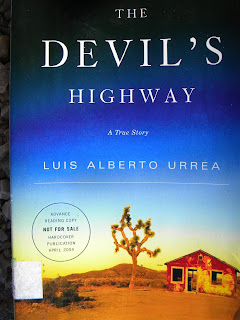
The Devil's Highway by Luis Urrea details the disastrous border crossing of some two dozen Mexicans in the Arizona desert. Wherever you stand on the issue of illegal immigration, Urrea's book delves into the details of the entire operation, from the men both young and old who look north for an answer to life's troubles, to the smuggling chain of command, to the Border Patrol and their methods for handling this unending assault. In his retelling, Urrea has a somewhat annoying habit of driving home a point using extremely colloquial language, but his eye for detail and drama make this an essential read for understanding the border conflict. A reviewer on the back of the book said something like "Read this book now." I thought at first that this was just the kind of garbage that publisher's love putting on books, but he was right. You need to read this book right now.
. . .
. . .
Dead Man's Walk is the first of the Lonesome Dove tetralogy detailing Gus and Call's beginnings, both as friends and Texas Rangers. It's a light read, full of everything you might expect from a non-Lonesome Dove novel. The bad guys range from the indomitable Comanches and Apaches to the Mexican army, and the good guys count among their numbers the famous Texan Bigfoot Wallace. You also get to read the first few moments between Gus and Clara (frankly, I read the story mainly for these passages). It's good fun, more popcorn for the LD fan, but perhaps less meaningful for someone unfamiliar with the original story.
.
A side note: My longtime friend admitted to me that he had neither seen nor read Lonesome Dove. If you are a born-and-raised Texan, you have got to carve out some time to experience this story. You'll get more out of it by reading the 900 page epic, but the 6-hour miniseries was so well done that the whole thing's become a toss-up. Fiction at its best.
. . .
. . .
The Tecate Journals is Keith Bowden's thru-adventure down the Texas section of the Rio Grande river. Sometimes with friends though mostly alone, he bikes and paddles every mile of this no man's land, spending time on both sides of the river and seeing the spectrum of humanity through everyone he meets. While the book does have its moments, there's a lot left to be desired. I got tired of reading that a couple of beers hit the spot or that some interaction was superlative in some way or another. There's a lot in the book for the canoeing enthusiast, especially if you're about to tackle little known sections of the Rio Grande, but the book falls short of the mark for the rest of us.
. . .
Until we meet again...

Tuesday, June 29, 2010

Books on the Edge

Don't be surprised here by the number of books. One's a comic book, another is really short, and I'm not yet done with the last one (but I'm getting there). There is a wide variety of genre and subject matter represented, and I like it that way. Enjoy.
. . .
. . .
That Old Ace in the Hole by Annie Proulx was, to be brutally honest, a letdown. Her story takes us into the heart of the Texas Panhandle, a region that I thoroughly enjoyed on my trip, but doesn't quite touch the real beauty of the place. I recognized several names from the Acknowledgments, and that was exciting. But it was all pretty much downhill from there.
.
Bob Dollar is paid to investigate potential sites for hogfarms, on behalf of a big corporation, in the panhandle of Texas. It doesn't sound like much of a plot (and it's not), but that's not the problem. Bob is unbelievable, a paper thin shell of a character, who never really makes the reader gave a darn about what happens to him.
.
The novel is propelled primarily by speech, and I smiled more than once at the way people talked. If Proulx did one thing right, it was in imitating the cadence and word choice of people in the region, but this skill does not and cannot hold the book up. Lovers of the panhandle might find some comfort in her talent, but they will have to dig much deeper to enjoy other aspects of the story.
.
Enough. The panhandle deserves a great book about its hardy population. This book is not it.
. . .
. . .
The Tortilla Curtain by T. Coraghessan Boyle is a fast-paced and enjoyable look at illegal immigration through the eyes of an upper-middle class family in California and a dirt-poor Mexican couple who just illegally immigrated to the same area.
.
There is no plot, per se. Events keep happening to each family which both directly and indirectly combine their fates. A California man accidentally hits the Mexican man with his car. Thus starts a whirlwind of related events, both understandable and tragic, distinct yet interconnected. Each man negotiates the ups and downs of his individual life, grappling with prejudice against the other and the injustices of life.
.
Boyle tears into the American family with sarcastic and searing remarks, and while it made me laugh, it also seemed a little unfair. He treats the Mexican family much gentler, tries hard to make them seem normal and hardworking, which they are. But the presence of judgment against the California residents and the absence of judgment against the illegal migrant workers is highly noticeable. There are a few nasty Mexican characters, yes, but it isn't judgment. Boyle mocks his white characters and their hardships while seeming to protect his Hispanic characters from the same narrative injustice.
.
I'd definitely recommend this book. Sure, a plotline was left unfinished, the ending is more poetic than final, but the story reads like a thriller. I couldn't put it down (not that I had a table) and laughed out loud many, many times. The author's prose is crystal clear, his pacing enjoyable, and as per the discrepancy between how he treats his characters, well, that's his choice.
. . .
. . .
Tales from the Terlingua Porch by Blair Pittman is a collection of stories, maybe a lot of hot air, from the many, many characters who visit the Terlingua Porch season after season. I read this book in an afternoon and was charmed by some of its informal tales. Pittman isn't J. Frank Dobie (who is?), but you get the feel for what people talk about in Terlingua Ghost Town. You might even learn a thing or two about life. There's a Part II, as well, if you can't get enough.
. . .
. . .
Night of the Grasshopper Mouse! by Chris Ruggia is a short, interesting comic about an aberration of nature, the cruel and unusual grasshopper mouse. Unbeknownst to me, a very small portion of mice turn into meat-eaters and attack their own kin. The comic details one such tale. This little story doesn't really target adults, but I think older elementary kids would like it.
. . .
. . .
Coyotes by Ted Conover is a first-person account of the trials of Mexican migrants crossing the border and finding work in the United States. Conover's tales are not information heavy, but they are fascinating nonetheless. He travels to Mexico and crosses multiple times as one of the millions who do so illegally every year, using coyotes and later experimenting with the coyote lifestyle himself (briefly, I might add). He makes friends, slaves away in orchards, crosses the USA in the worst kind of vehicles, and documents all the little details along the way. He was very sympathetic to his Mexican friends back in the 80s when he wrote this book and still seems very much on the side of the men and women who just want to make a living, even if that means breaking the law. Like Boyle does in fiction, Conover puts a human face on these individuals, which to me far outweighs any bias he may have imposed on the telling of his tales. A good read.
.
(Notice the cover, by the way. This book got completely soaked in Big Bend.)
. . .
. . .
Desert Solitaire by Edward Abbey chronicles his six-month stay in Arches National Monument. I'm not actually done with this book, but I've read enough to comment a bit. Abbey is a hardnose environmentalist who admires nature and all its harshness and glory and relates more to the past than to the realities of today. It's a wonderful read (that is, full of wonder). What I like about Abbey is what Republicans liked about George W. Bush: he makes a statement or opinion and then defends it until the end of his life. (The Democrats could stand to learn a thing or two from this kind of hardlined perspective.) Abbey rips into the National Park Service, the condition of the modern Native American and cattleman, and even into his own capacity for hard work. If you want to read a book by someone who fiercely loves life and nature, who doesn't cower when he has to give a difficult-to-hear opinion, who represents much of the aggression that the rest of us lack, then pick up Desert Solitaire.
.
(Notice this cover, too. On one particularly feisty night, Raisin got her teeth into this one.)
. . .
. . .
Enjoy! Until next time...

Tuesday, April 13, 2010

Books on the Edge

I do a lot of reading out here, usually at breaks and before sleep but on a nice day you can find me reading while walking. I have tried to read what might enrich my walk around Texas, though I change it up from time to time. As per books that pertain directly to the state, I present the following:
. . .
. . .
In Brownsville, Oscar Casares presents nine fictional stories about life in Brownsville, Texas. Why then, you might ask, is there a really long tail on the cover of the book? The tail belongs to the collection's only monkey, which makes an entrance in just one tale, though in the story, only the monkey's head plays a role. I had my doubts, reading about Bony and his bizarre obsession with the monkey's head which ultimately puts him at odds with his parents, but Casares made the darn thing work. In fact, I found myself getting into the lives of his characters more than I thought I would: a boy who gets a job working at a fireworks stand, a female bowler whose lucky ball gets stolen, a father whose son isn't tough enough for him. The prose is simple and straightforward, the commentary on life and purpose profound. And when there's a joke, which Casares works in form time to time, it's a long, hard belly laugh. Enjoy.
. . .
. . .
Ron Hall and Denver Moore (with Lynn Vincent) share the tale of their friendship in Same Kind of Different as Me. Set in and around Fort Worth, a homeless man (Denver Moore) eventually runs into a wealthy couple (Ron and Deborah Hall) trying to spread some love at the local homeless shelter. After a vision, Deborah is convinced that Denver is important to their lives and that they need to reach out to him. Eventually, Denver reaches back, and during the rest of the story, they all learn about friendship, devotion, spirituality, and love. A quick, uplifting read.
.
Though no doubt true, it was a little happy-happy joy-joy for me. I have a new perspective on the whole thing after being out here on the road. I can sense the difference between pity and a genuine helpful attitude. Both come from the same place, and while it's easy for a recipient to see the difference, it seems to be extremely hard for the giver to differentiate. I'm not the only who understands this either. A store owner back at the start of the panhandle commented on his assistant who gave me a candy bar before he clocked out for the day. After the guy left, he said, "See that? He thinks he's better than you, like he's the big man helping out the poor. All he sees is the backpack." I'm not saying that's what happened in the above book, but my experiences have allowed me to read it in a different way, perhaps the same kind of different way as you.
. . .
. . .
The Worst Hard Time by Timothy Egan is still a book I'm working on, but it is fantastic. It details the general story of the Great American Dust Bowl while bringing the whole disaster to life with the personal tales of survival of about half a dozen main characters. I'm 200 pages into this 300 page book, and all the details have come together beautifully. I'm shocked. I don't remember enjoying Grapes of Wrath by John Steinbeck at all (that was in high school, though). It helps that I've walked through some of the towns he mentions (Follett, Oslo, Darrouzett, Texhoma, Dalhart), but the story stands on its own. The Worst Hard Time is fascinating and wonderfully told. Read it, read it, read it. While the cover quote is a little cheesy ("This is can't-put-it-down history." - Walter Cronkite), it is so so true.
.
(Side note: Today is April 14th, the 75th anniversary of Black Sunday, the worst duster in the history of the whole mess.)
. . .
. . .
Until next time, readers...